

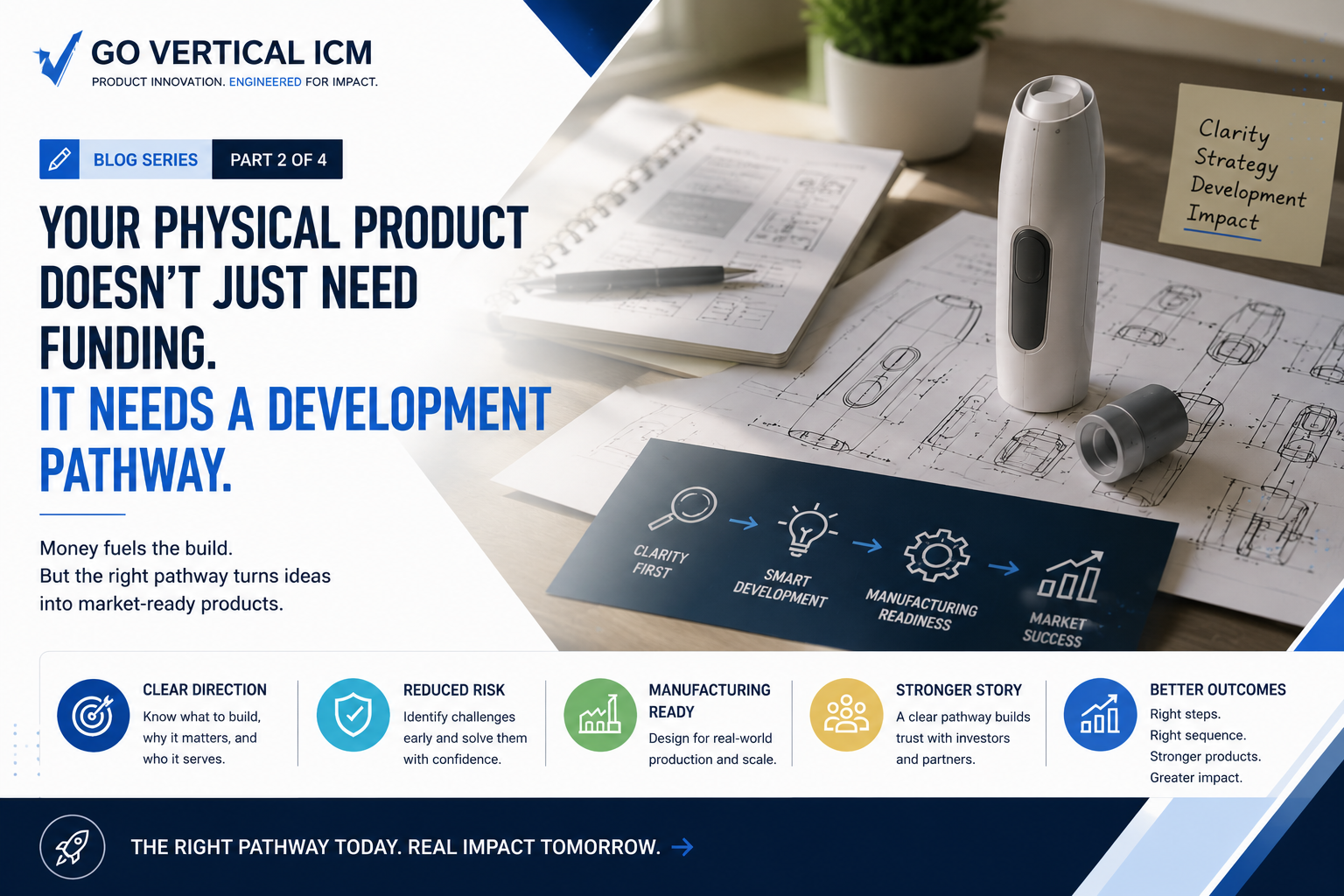
Many founders believe funding is the main thing standing between their product and the market.
Sometimes that is true.
But often, the deeper issue is not money.
It is the absence of a clear development pathway.
For physical product founders, capital can disappear quickly when the sequence is wrong.
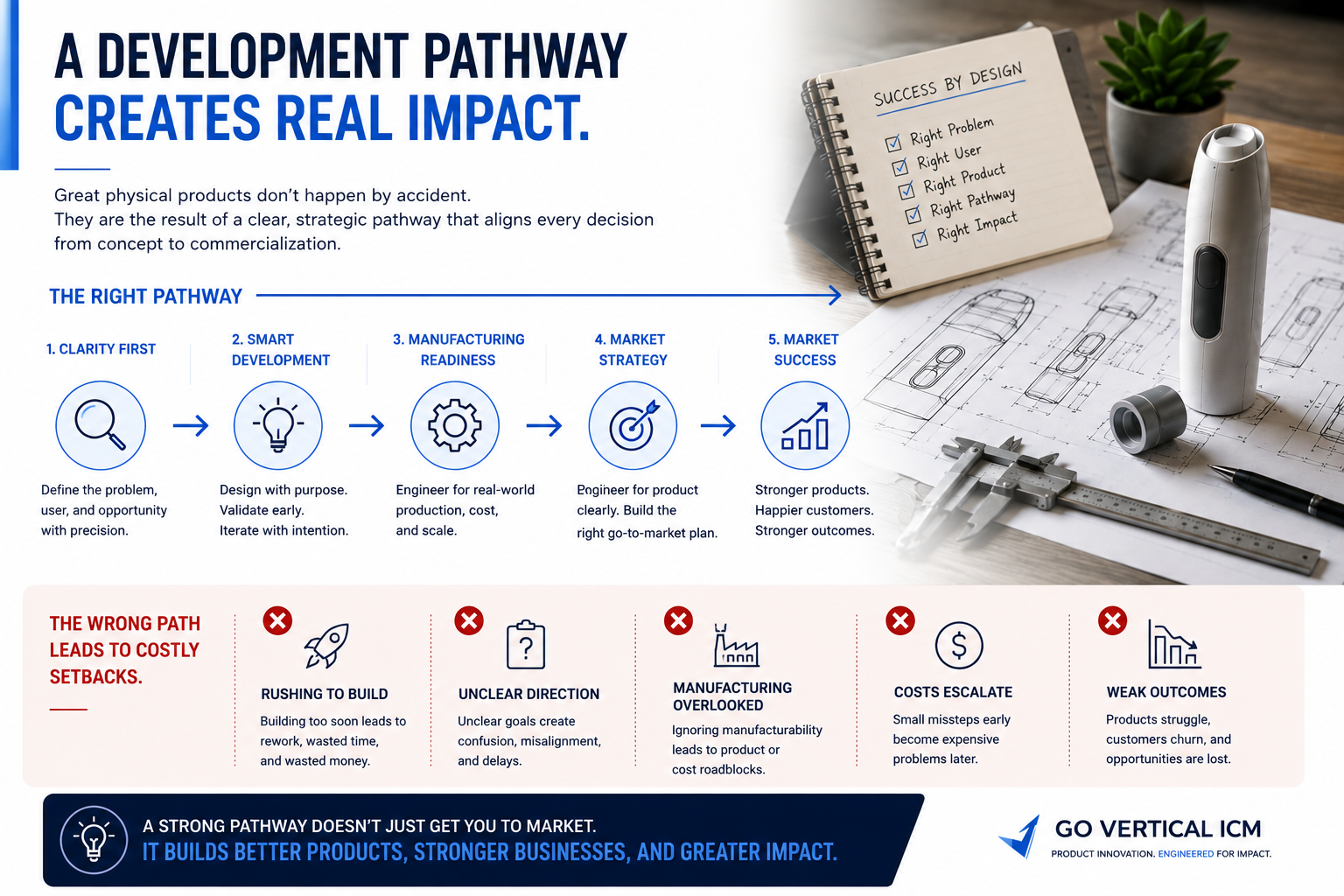
Money spent before clarity can go into the wrong prototype, the wrong manufacturer, the wrong materials, the wrong branding, or the wrong go-to-market plan.
Funding helps most when the founder knows exactly what the money is meant to unlock.
The Problem With Moving Too Fast
A founder may rush into:
- building a prototype before defining requirements
- contacting manufacturers before understanding design constraints
- creating branding before the product direction is stable
- pitching investors before the cost and timeline are credible
- pursuing regulatory steps before understanding product classification
- launching before the customer use case is clear
Each of these moves can look like progress. But progress in the wrong direction creates rework.
Physical Products Need Sequencing
Physical product development is not one decision.
It is a chain of connected decisions.
- Product definition affects engineering.
- Engineering affects manufacturability.
- Manufacturing affects cost.
- Cost affects pricing.
- Pricing affects market strategy.
- Market strategy affects investor confidence.
When one piece is unclear, the entire pathway becomes weaker.That is why founders need more than funding.
They need sequencing.
What a Development Pathway Should Clarify
A strong development pathway should answer:
- What are we building first?
- What stage is the product in now?
- What assumptions need to be validated?
- What technical risks exist?
- What manufacturing risks exist?
- What will the next milestone cost?
- What does the product need before market?
- What should we not spend on yet?
This clarity helps founders avoid expensive mistakes.
Why Money Alone Is Not Enough
Money does not automatically create strategy.
It can fund execution, but it does not determine whether the execution is right.
A founder with $50,000 and no roadmap may waste it.
A founder with $10,000 and the right sequence may make meaningful progress.
The difference is not only capital.
It is clarity.
The Investor and Partner Perspective
Investors, partners, and manufacturers do not just want to know that a product is interesting.
They want to know:
- Is the product feasible?
- Is the customer clear?
- Is the development path realistic?
- Are the risks understood?
- Is the next milestone credible?
- Can the founder execute?
A strong development pathway makes the opportunity easier to understand and easier to support.
The Founder’s Advantage
When founders have a clear pathway, they make better decisions.
They know what to build now.
They know what to postpone.
They know what to validate.
They know what to ask from partners.
They know how to explain the opportunity.
That is what creates confidence.
Funding matters.
But funding without structure can accelerate confusion.
Before seeking money, support, or market entry, physical product founders should ask:
Do we know the right next step, or are we just trying to move forward?
The strongest founders are not the ones who do everything at once.
They are the ones who know what must happen next.
If your product is moving from concept toward development, take time to clarify the pathway before investing deeper resources into the build.