

Executive Diary Magazine Feature
Michael Khoury, CEO and co-founder of Go Vertical ICM, was recently featured in Executive Diary Magazine, where he discussed one of the most common challenges innovators face: transforming promising ideas into products that can successfully reach the market.
Innovation is often associated with creativity, invention, and breakthrough ideas. However, as Michael explains in the feature, the real challenge begins after the initial concept stage. Many organizations and founders excel at generating ideas and building early prototypes, but far fewer succeed at navigating the complex path required to transform those ideas into scalable, market-ready products.
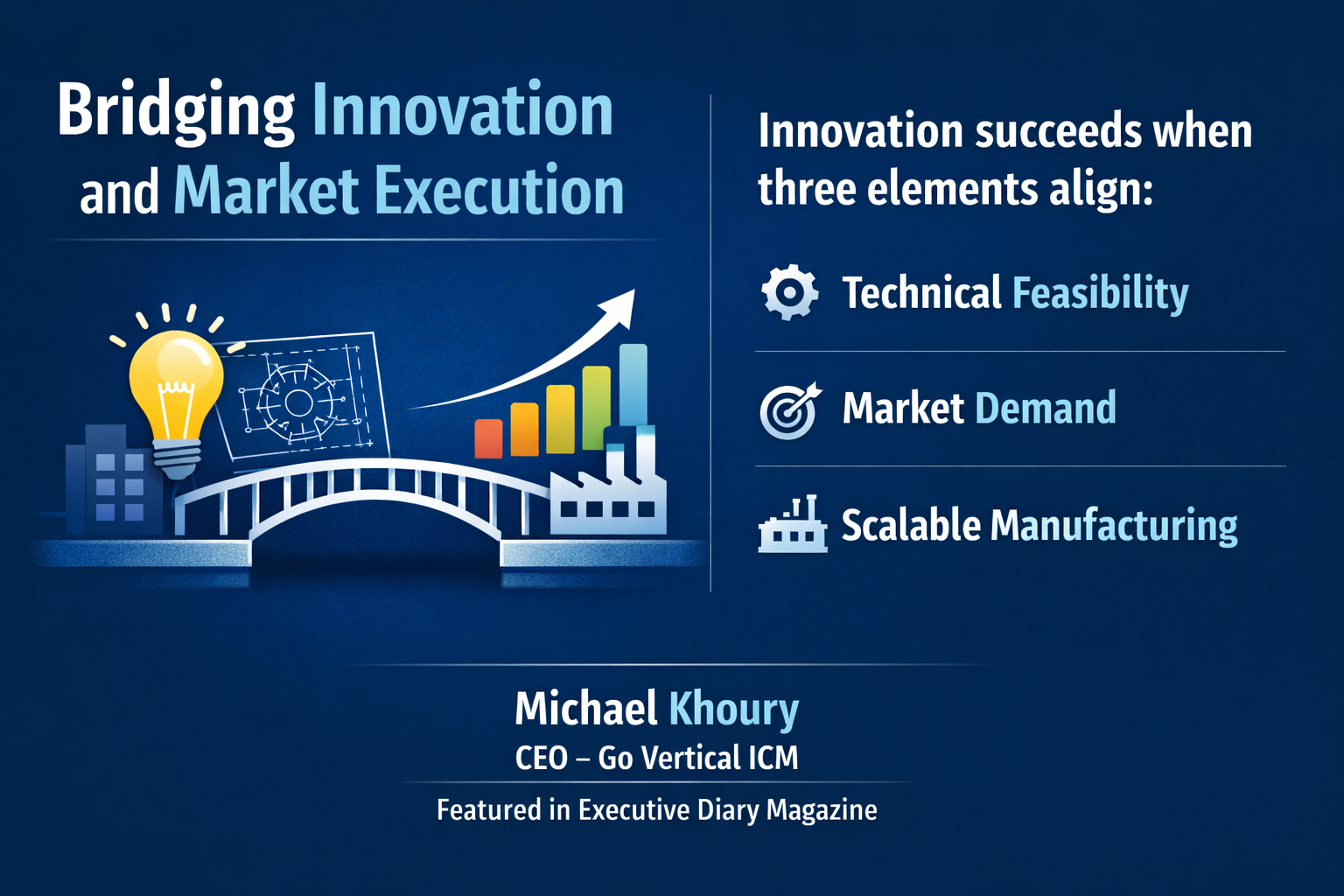
According to Michael, the success of an innovation depends on the alignment of three fundamental elements:
- Technical feasibility – the ability to design and engineer a product that functions reliably and meets performance expectations.
- Market demand – clear validation that the problem being solved matters to customers and that the solution provides real value.
- Scalable manufacturing – the capacity to produce the product efficiently and consistently at a scale that supports commercial growth.
When any one of these elements is missing, even highly innovative concepts can struggle to move beyond the development stage.
For example, a technically sophisticated product may fail if it cannot be manufactured at a cost that supports the target market. Similarly, a product that performs well technically may struggle if its value proposition is not clearly aligned with customer needs.
Michael emphasizes that successful innovation requires early strategic thinking about commercialization, not just engineering. By addressing feasibility, manufacturing, regulatory considerations, and market positioning early in the process, founders and innovators can significantly reduce the risk of costly delays or misaligned product development.
At Go Vertical ICM, Michael and his team focus on helping innovators navigate these complexities by turning early-stage concepts into structured execution roadmaps. This process helps founders clarify the steps required to move from invention to commercialization while minimizing uncertainty along the way.
The goal is not simply to build products, but to ensure that innovations are positioned to succeed in real-world markets.
Read the full article in Executive Diary Magazine here