

Taking a hardware product from prototype to reliable production is where many good ideas stall.
You’ve proven the concept, users love the early version, and you may even have investor interest—but converting that into a repeatable, scalable manufacturing setup is a different challenge:
- Which manufacturing process should you choose?
- How do you find and qualify a factory you can trust?
- What changes are needed to make your design manufacturable at cost and at scale?
This is exactly where custom manufacturing services and a structured manufacturing partner can remove risk and confusion.
At Go Vertical ICM, we support inventors, MedTech and Femtech founders, and hardware startups from Strategic Discovery through to Manufacturing Mastery. In this article, we’ll outline how custom manufacturing services work, what to look for in a manufacturing partner, and how to move from prototype to production without losing control of quality, cost or timelines.
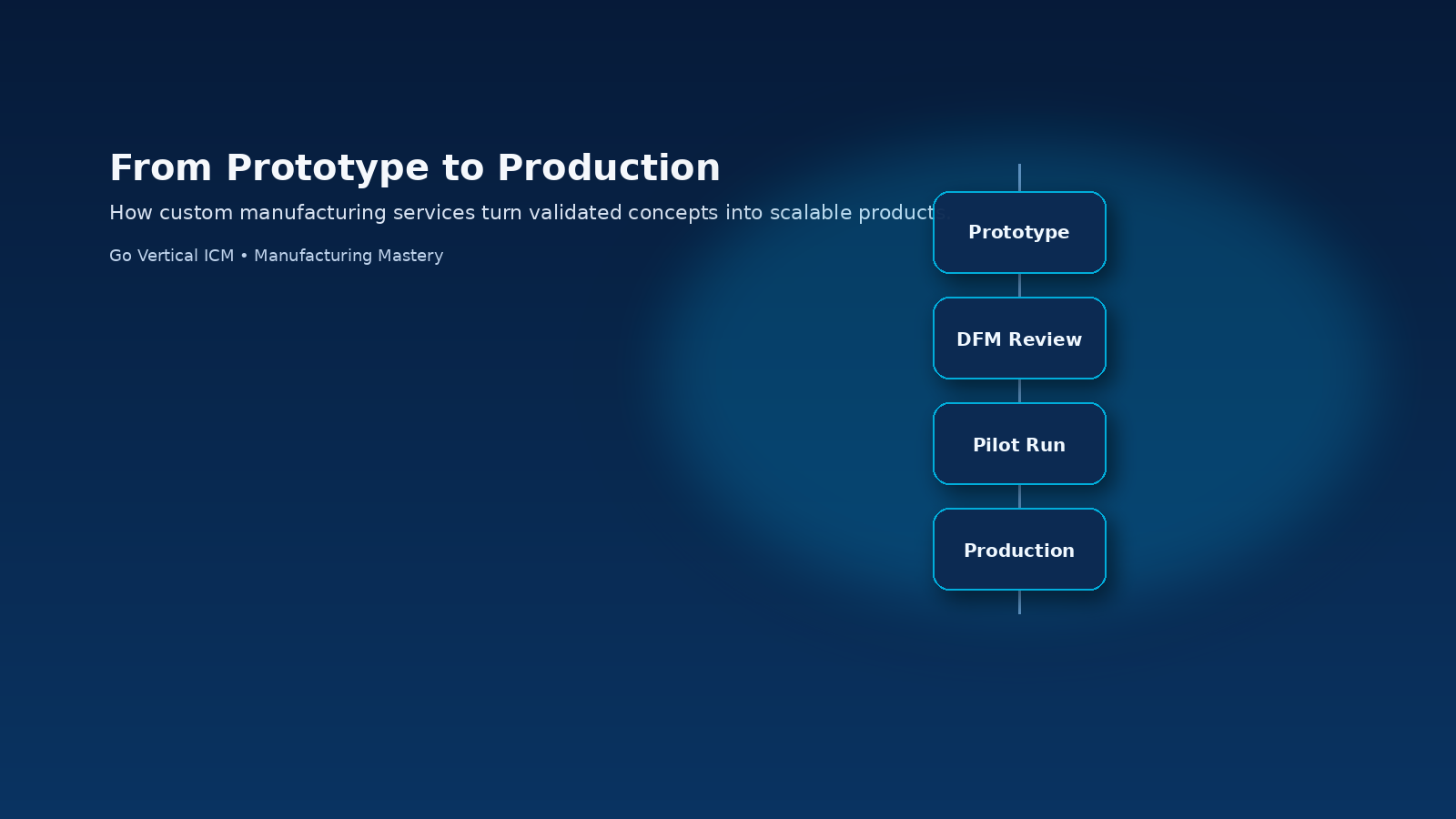
Why manufacturing is different from prototyping
Prototypes are designed to prove concepts. Manufacturing is designed to repeat them.
That difference affects almost everything:
- Materials – What works for one-off prototypes may be too expensive, slow or fragile for production.
- Tolerances – Hand-built prototypes can hide fit and alignment issues that will show up when you produce at volume.
- Tooling – Injection moulds, dies, jigs and fixtures have upfront costs and lifetimes that must be planned for.
- Quality & compliance – Production requires consistent quality and may bring additional testing, certification and documentation.
Custom manufacturing services exist to bridge the gap between an exciting prototype and a real, scalable production system.
What custom manufacturing services typically include
Every manufacturer and product development company packages services differently, but for founders and innovation teams, the value usually sits in five areas.
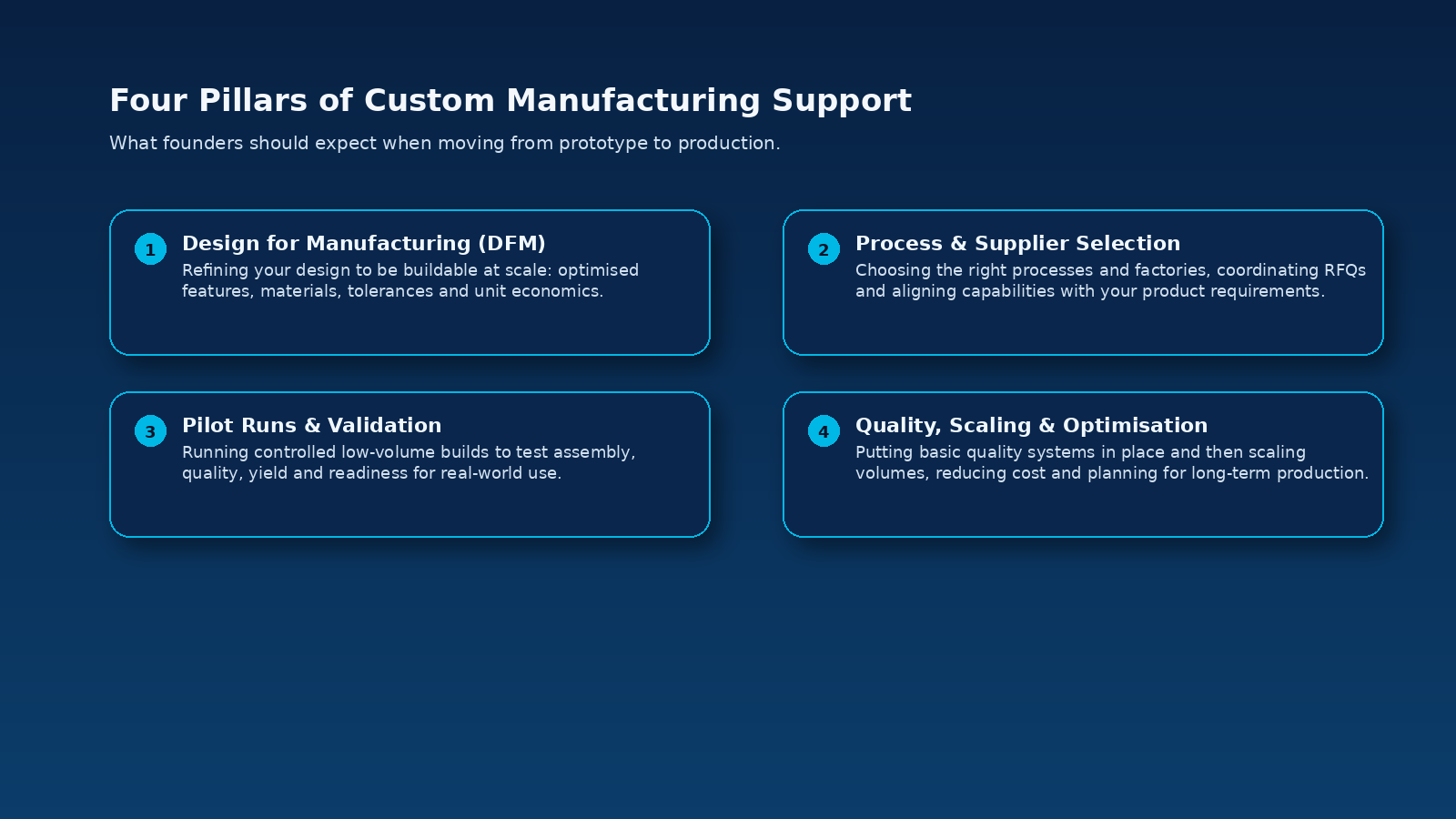
1. Design for Manufacturing (DFM) review
Before you ask for quotes, a serious partner will perform a Design for Manufacturing (DFM) review to:
- Identify features that are difficult or expensive to produce.
- Suggest changes to reduce complexity, scrap and assembly time.
- Align material choices and tolerances with realistic production capabilities.
At Go Vertical ICM, we treat DFM as a structured checkpoint between R&D and manufacturing. The goal is to preserve the core function and user experience while improving manufacturability and unit economics.
2. Process and supplier selection
Not every factory and process is right for your product.
Custom manufacturing services help you:
- Decide which processes to use (e.g. injection moulding, CNC machining, die casting, overmoulding, sheet metal, textile fabrication).
- Shortlist suitable manufacturing partners by geography, capabilities, certifications and capacity.
- Coordinate RFQs (requests for quotation) and compare options on more than just headline price.
For MedTech and health-related products, supplier selection will also consider:
- Cleanliness and quality systems.
- Traceability and documentation.
- Ability to support audits and regulatory expectations.
3. Pilot runs and validation
Moving straight from prototype to full-scale production is risky.
A good manufacturing partner will plan staged validation:
- Engineering or pilot builds at low volume to test assembly, quality, and yield.
- Adjustments to tooling, fixtures and work instructions based on real-world results.
- Early checks on packaging, labelling, and logistics.
The aim is to discover problems when you can still adjust economically—not when you already have thousands of units in the field.
4. Quality and consistency systems
Custom manufacturing is not just about making parts; it’s about making them the same way every time.
Manufacturing support should cover:
- Incoming inspection criteria and basic acceptance rules.
- In-process quality checks at critical steps.
- Final inspection criteria, including functional tests where relevant.
- Documented change control, so design or process changes do not accidentally invalidate certification or testing.
For MedTech and similar categories, this connects directly to regulatory expectations and quality management requirements.
5. Scaling and optimisation
Once the first stable production runs are achieved, the focus can shift to:
- Scaling volume while maintaining quality.
- Exploring cost reduction through process optimisation, tooling improvements or supplier negotiation.
- Planning for second-source suppliers or additional manufacturing locations if needed.
A strong partner will treat manufacturing as a living system, not a one-time event.
What to look for in a manufacturing partner if you are an inventor or startup
Founders and innovation teams have different needs from large corporates. When you evaluate custom manufacturing services, consider:
1. Experience with early-stage products
Ask whether they have worked with:
- Startups or inventors who are still refining their design, or
- Only large companies with fully locked specifications.
You need a partner who is comfortable with:
- A bit of iteration,
- Educating you on trade-offs, and
- Making sure your first production run is feasible, not just theoretically perfect.
2. Transparency in costs and minimums
Request clarity on:
- Minimum order quantities (MOQs).
- Tooling costs and ownership (who owns the moulds, jigs and fixtures).
- Per-unit costs at different volume tiers.
- Any extra fees (engineering changes, storage, line set-up, etc.).
This transparency matters when you’re trying to align production with cash flow, pre-orders or staged funding rounds.
3. Alignment with your quality and regulatory needs
If you are building a medical device, femtech product, wearable or safety-critical product, your partner should understand:
- Relevant standards and testing requirements.
- The documentation you’ll need for audits or regulatory submissions.
- How changes in materials or processes may affect compliance.
At Go Vertical ICM, we explicitly integrate regulatory and compliance thinking into the Manufacturing Mastery stage for MedTech and femtech founders.
4. Communication style and project management
You’ll be dealing with:
- Different time zones,
- Different languages and working styles, and
- Complex technical information.
Look for partners who:
- Provide clear points of contact.
- Use simple, structured updates.
- Are willing to jump on review calls to walk you through issues and options.
How Go Vertical ICM approaches manufacturing support
Our role is to act as a bridge between your product vision and the manufacturing environment.
Typically, this looks like:
1. Strategic Discovery (SD)
- We clarify feasibility, roadmap, risk and high-level cost ranges before you commit to manufacturing.
2. R&D and DFM under CAP
- Inside the Creation Accelerator Program, we refine your design with manufacturability and regulatory pathways in mind, not as an afterthought.
3. Manufacturing Mastery
We support:
- Supplier identification and selection.
- Tooling specifications and DFM reviews with manufacturers.
- Pilot runs, iterations and quality system basics.
- A path toward scalable, repeatable production.
Our focus is always on hardware and hardware-plus-software products—no purely digital platforms—because that’s where manufacturing decisions are most critical and most complex.
When to involve a manufacturing partner
The best time to bring in custom manufacturing support is earlier than most founders expect—but not before you’ve done your strategic homework.
A simple rule of thumb:
- If you do not yet understand feasibility, risk, regulatory direction or cost ranges → you are likely still in Strategic Discovery territory.
- Once you have a clear roadmap and validated concept, and you’re starting to ask:
- “What factory type do we need?”
- “What tooling will this require?”
- “What volumes should we plan for?”
- …then it is time to engage a manufacturing partner.
That way, you’re not forcing manufacturers to do feasibility work they’re not set up for, and you’re not committing to production with an unclear plan.
Bringing your product from prototype to production, safely
For inventors and startups, manufacturing is not just a technical step—it’s a strategic decision that affects risk, funding, margins and brand.
Custom manufacturing services should give you:
- A design that is ready for production, not just a good-looking prototype.
- A clear view of costs, volumes and trade-offs.
- Confidence that your manufacturing system can support compliance, quality and growth.
If you are preparing to move a MedTech, Femtech, wearable, consumer or industrial product from prototype to production and want structured support, Go Vertical ICM’s combination of Strategic Discovery, CAP and Manufacturing Mastery is designed to guide you through each stage.
Next step:
Use Strategic Discovery to confirm feasibility and the right manufacturing direction—then move into a structured execution plan under the Creation Accelerator Program.
Remember to to connect the internal pages – all the key words such as Strategic Discovery or the Creation Accelerator Program