

Why the Right Product Development Partner Matters
A serious product development company does more than “make a prototype.” It should:
- Help you decide whether the product should be built at all.
- Translate your idea into clear technical requirements and realistic scenarios.
- Map a pathway from concept to manufacturing and commercialization, not just a one-off design.
- Work in a way that protects your IP and keeps ownership clearly with you.
If a potential partner cannot explain how they do these four things, they are not a long-term innovation partner – they are a vendor.
1. Check Their Focus: Are They Actually a Product Development Company?
Many agencies call themselves a product development company USA, but their core expertise may be:
- Industrial design only
- Marketing or branding
- Generic “innovation consulting” without execution
When evaluating a new product development company, look for:
- Clear examples of hardware, medical devices, wearables or physical products.
- A portfolio that shows engineering, prototyping, and manufacturing handover, not just renderings.
- Service pages that explicitly mention product development services, research & development, prototyping and manufacturing support.
If their best work is logos, packaging or apps, they might be a valuable branding or digital partner – but they are not the team that should own your product’s technical roadmap.
2. Look for a Strategic Front-End, Not Just Design
Before you spend money on CAD, tooling or prototypes, you need structured answers to questions such as:
- Is this technically feasible with realistic constraints?
- Is there a clear use case and target customer?
- What are the likely cost ranges and timelines?
- What major risks – technical, regulatory, manufacturing – should be addressed early?
A credible product development services provider will have a front-end strategic phase (often called feasibility, discovery or evaluation) with outputs such as:
- Feasibility and risk assessment
- Preliminary development roadmap
- Early bill-of-materials ranges and phase estimates
- Recommendations on whether and how to proceed
If a partner wants to jump directly into design and prototyping without this step, you may end up with a polished artefact that is hard to manufacture, hard to fund, or misaligned with your actual market.
3. Evaluate End-to-End Capability: From R&D to Manufacturing
Some teams are excellent at early strategy but disappear at the execution stage. Others are strong in engineering but never think about:
- Regulatory constraints
- Supply chain and manufacturing partners
- Packaging, readiness for retail or digital marketplaces
When assessing a new product development company, ask:
- Do they offer R&D and engineering services (not just sketches)?
- Can they support prototype development and iteration?
- Do they understand manufacturing methods, tooling, and DFM (design for manufacturability)?
- Do they have experience with MedTech, wearable tech, consumer products or industrial hardware, depending on your category?
You do not necessarily need one firm to do everything end-to-end, but you want a partner who can:
- Build a holistic roadmap
- Coordinate with other specialists (IP counsel, regulatory experts, manufacturers)
- Stay involved from concept through to manufacturing handover
4. Understand How They Handle Intellectual Property
This is one of the most important aspects when choosing a product development company in the USA.
You should be absolutely clear on:
- Who owns what IP, and when
- How background IP (what you bring) and foreground IP (what is created during the project) are treated
- Whether they will ever claim ownership or co-ownership of your product designs
- How they handle confidentiality, NDAs and conflict of interest
Key points to look for in contracts and proposals
- Your company (or you as the inventor) should own all IP created for your project once agreed fees are paid.
- The company may retain rights to its internal processes, tools and frameworks, but not your concept.
- There should be a clear confidentiality agreement covering ideas, drawings, test results and technical information.
- They should not reuse your concept with another client, even if they work in similar categories.
Red flags
- Vague language about “shared IP” or “co-ownership” without clear definition.
- A requirement to assign partial rights to the company for future commercialisation.
- Reluctance to sign NDAs or to define IP ownership in writing.
A strong partner will welcome these discussions. They know that protecting your IP is in everyone’s best interest and that their role is to provide product development services, not to appropriate the product.
5. Clarify Their Financial Model and Risk Sharing
The financial structure behind the relationship matters as much as the technical capability.
Ask:
- Do they work only on large upfront retainers, or do they offer staged work?
- Is there a clear link between deliverables and payments?
- For longer timelines (24–60 months), do they offer a structured monthly model or only ad-hoc projects?
A transparent model will typically include:
- A clear scope for each phase (strategy, design, prototyping, pre-production)
- Defined deliverables and decision points
- Transparent rates and payment terms
- No hidden obligations for exclusivity or future revenue share unless explicitly negotiated
If you are an early-stage founder, look for partners who balance:
- Professional-level work with
- Manageable, predictable costs over time, rather than one large invoice with no clear roadmap.
6. Assess Their Process, Communication and Documentation
A serious product development company should be able to explain:
- How they run projects (phases, milestones, reviews)
- How often you will receive updates
- What kind of documentation you will receive (reports, CAD files, test summaries, handover packages)
Ask them to walk you through a “typical” engagement from:
- Initial discovery
- Strategic assessment / feasibility
- Design and engineering
- Prototyping
- Preparation for manufacturing and commercialisation
You want:
- Clear expectations around who makes which decisions
- Visibility on what will be documented and yours to keep
- Evidence that they have worked with clients who are not engineers and can communicate accordingly
7. Look for Real Evidence: Case Studies, Testimonials, Sectors
Finally, look at their results, not just their promises.
Ask for:
- Case studies of similar product types (e.g. a medical device, a consumer product, a wearable).
- Examples where they worked with early-stage inventors or startups, not just large corporations.
- Instances where they supported commercialisation or manufacturing handover, not just early design.
If you work in MedTech, Femtech or other regulated spaces, look specifically for:
- Experience with regulatory considerations as part of development
- Awareness of documentation and traceability expectations
- Realistic views on timelines for regulated products (often 36–60 months, not 6–12)
Questions to Ask Before You Sign
Here is a practical checklist you can use in your first or second call with any product development company USA:
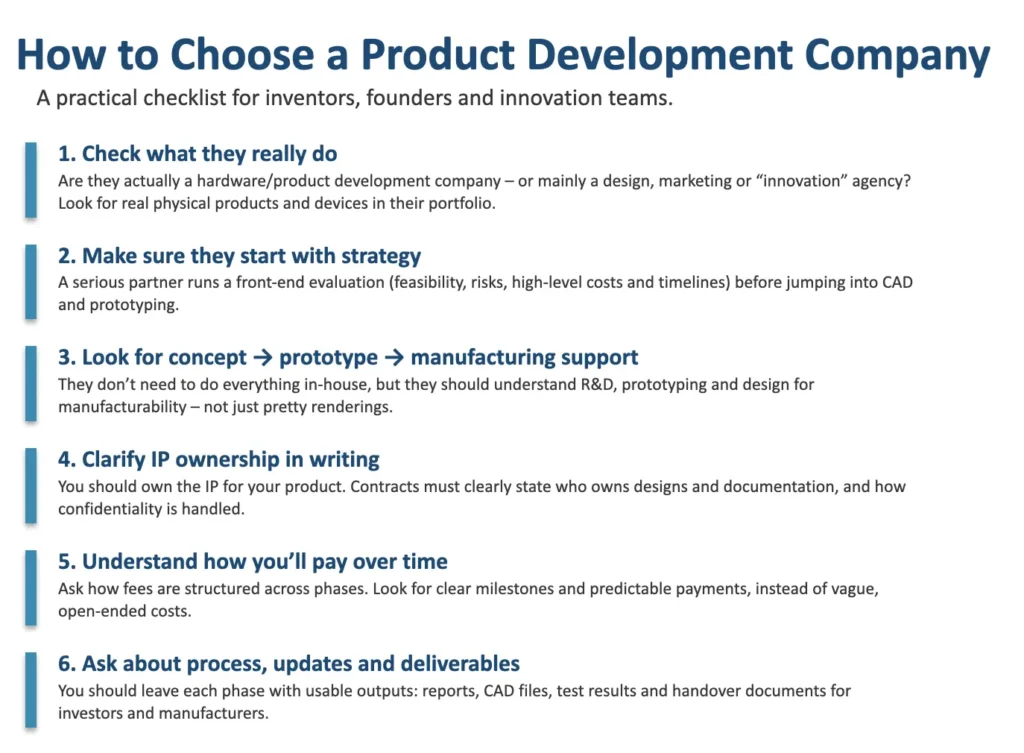
If a potential partner cannot answer these questions clearly, you may not have a shared understanding of what “product development” actually means in your context.
How Go Vertical ICM Approaches Product Development
Go Vertical ICM operates as a product development company focused on complex physical products and devices, with a structure that protects founders and their IP while giving them a clear path from idea to market.
Our approach typically follows three core stages:
- Strategic Discovery
- Feasibility, risk and roadmap assessment
- Investor-ready view of costs, timelines and major decisions
- Clear recommendation on whether and how to progress
- Creation Accelerator (CAP)
- Structured R&D, design, engineering and prototyping
- Fixed, predictable monthly financial model over defined timelines
- Close coordination with IP counsel, regulatory experts and manufacturing partners
- Manufacturing & Commercialisation Support
- Design for manufacturability and supplier briefing
- Support in coordinating manufacturing runs and preparing for market entry
- Alignment with your long-term product and portfolio strategy
At every stage:
- You retain ownership of your IP, designs and documentation.
- We treat your ideas and data as confidential.
- Our work is designed to stand up to scrutiny by investors, partners and regulators.
Final Thoughts
Choosing a new product development company is not only a technical decision – it is a strategic partnership and a trust decision.
If you:
- Ask the right questions,
- Clarify IP ownership early,
- Look beyond pretty prototypes to roadmaps, feasibility and regulatory awareness,
You significantly increase your chances of ending up with a product that is not only buildable, but also fundable, manufacturable and protected.